
Learning how to crochet starts with three things: a hook that fits your yarn, a yarn that shows its stitches, and a way of holding both that feels natural. Get those right and the stitches follow quickly, because every crochet stitch is built from the same two movements.
This guide walks you through the basics in the order I would teach them in person: what to buy, how to read the yarn label, the two ways to hold a hook, how to tension the yarn, the stitches to learn first and a small project to practice on. Each stitch then has its own lesson with close-up photos of every step.
What You Need to Start
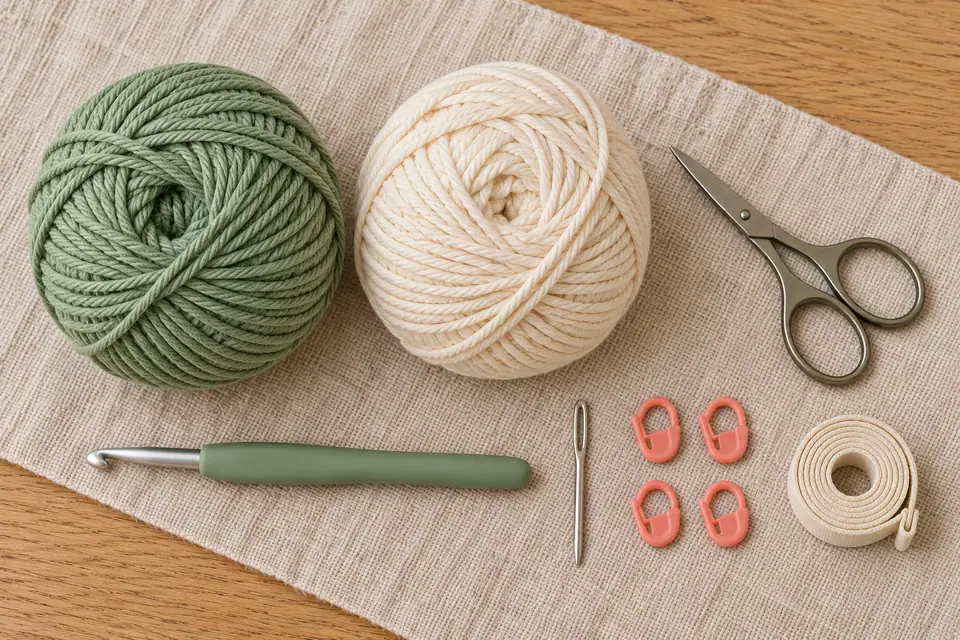
You need very little, and nothing expensive. Buy one good hook and one ball of the right yarn before you buy anything else; the rest can wait until a pattern asks for it.
- One crochet hook, 5 mm (US H-8) or 5.5 mm (US I-9). These sizes suit the worsted yarn below and are big enough to see every loop. A hook with a soft, flat thumb rest is easier on the hand for long sessions.
- One or two balls of worsted weight (4) yarn in a light, solid color. More on choosing it below.
- Small scissors and a blunt yarn needle for weaving in the ends.
- A few locking stitch markers. Safety pins or a scrap of contrasting yarn work too.
- A tape measure, for checking the size of your work later on.
Choosing your first hook
The crochet hooks for beginners that cause the least trouble are smooth aluminium or ergonomic hooks in the 5 to 5.5 mm range. Wooden and bamboo hooks are lovely, but they grip the yarn a little, which makes it harder to slide loops along the shaft while you are still learning the movement.
Hooks are sold in millimeters, US letters and numbers, and sometimes old UK numbers. The millimeter size is the one that matters, because it is the diameter of the shaft and it decides the size of every loop. Our hook size chart puts all three systems side by side.
You will also notice two head shapes. An inline hook has a throat cut straight into the shaft and a head the same width as the shaft; a tapered hook has a rounder head that narrows into the throat. Neither is better. If the yarn keeps slipping off the head, try the other shape.
Choosing your first yarn
The best yarn for beginner crochet is smooth, light in color and of medium thickness. Smooth, because you need to see where each stitch begins and ends. Light, because dark yarn hides the stitches in shadow. Medium, because thin yarn needs a small hook and very thick yarn is clumsy to tension.
In practice that means a worsted weight (4) acrylic or cotton in cream, pale grey, sage or another soft color. Acrylic is soft, stretchy and cheap, so it forgives uneven tension. Cotton shows the stitches very clearly and makes useful things like dishcloths, but it has no stretch and can feel hard on the hands at first. Avoid fuzzy, bouclé, eyelash and very dark yarns until the stitches feel automatic. The yarn weight guide shows all the weights from lace to jumbo.
How to read a yarn label
Every ball comes with a paper band that tells you most of what you need: the fiber, the weight and length of the ball, the yarn weight number, the hook and gauge the maker suggests, the care symbols, and the color and dye lot. The dye lot matters more than people expect. Yarn is dyed in batches, and two balls of the same color from different lots can look slightly different side by side, so buy every ball for one project from the same lot.
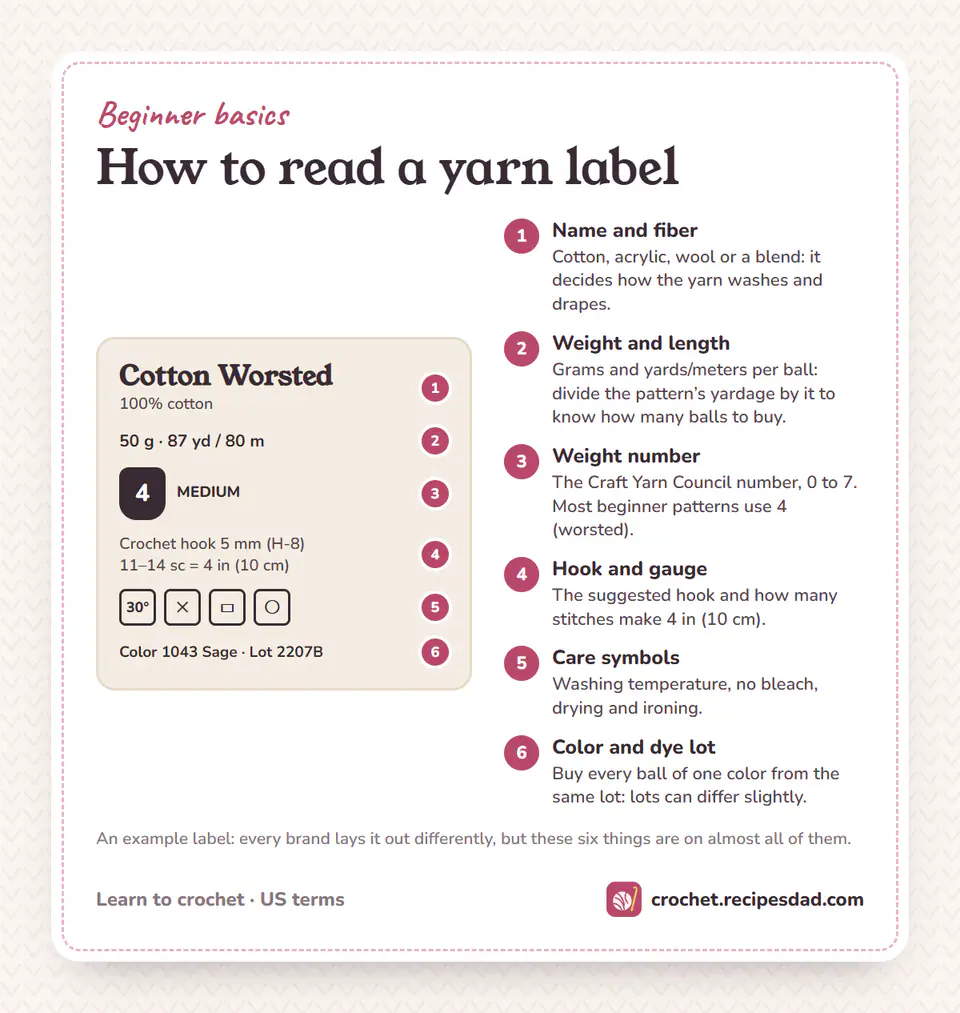
To know how many balls a pattern needs, divide the yardage it asks for by the yardage on one ball and round up. The yarn yardage calculator does the sum for you and adds a little extra for the gauge swatch.
How to Hold the Hook and the Yarn
Right-handed crocheters hold the hook in the right hand and the yarn in the left. If you are left-handed, swap everything: hook in the left hand, yarn in the right. The movements are the same, only mirrored, and your work will look just like a right-hander’s turned over.
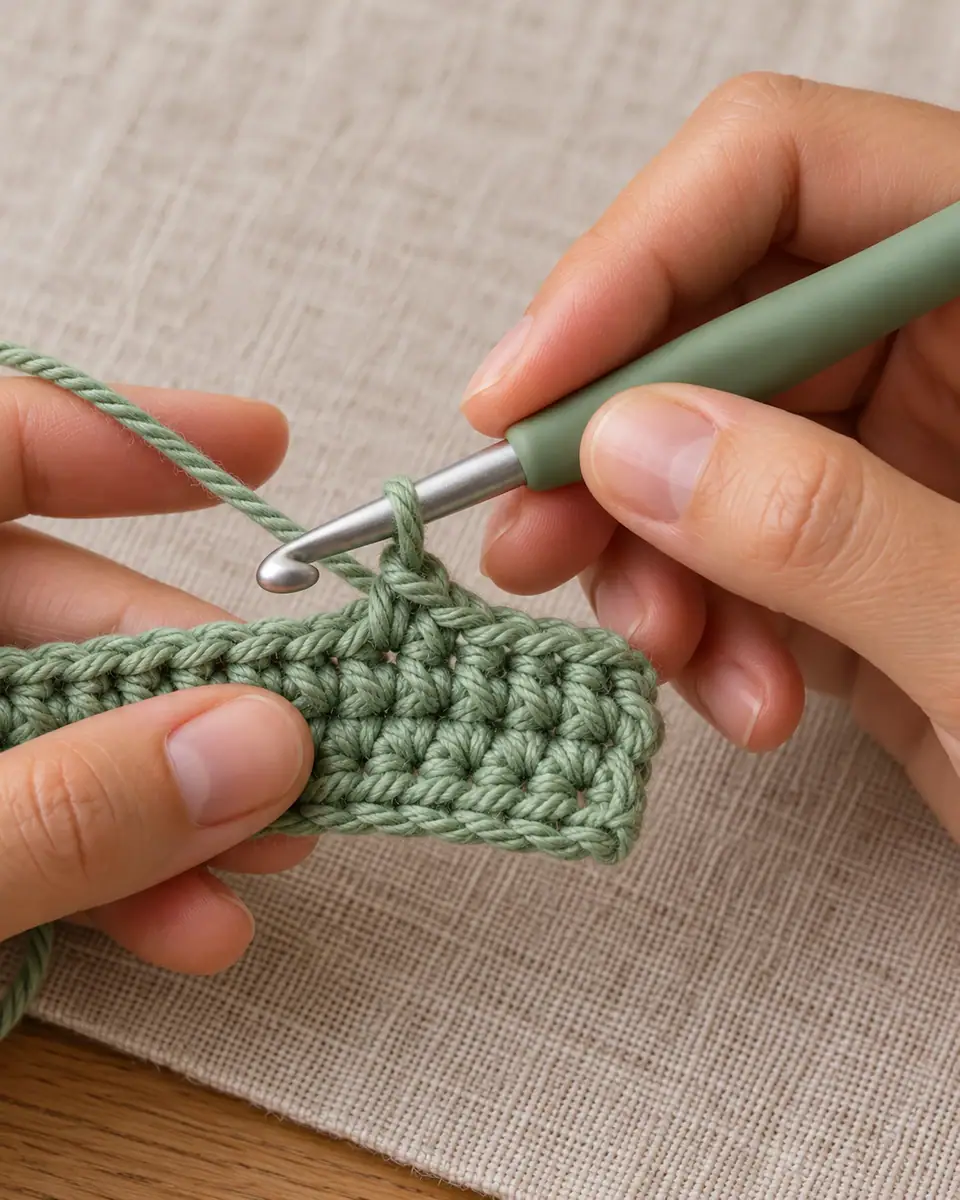
Pencil grip
Hold the hook as you would hold a pencil: the thumb and index finger pinch the flat part of the handle, and the shaft rests on the middle finger. The hook tip points slightly toward you. Most of the movement comes from the fingers and the wrist, which makes it a precise grip for small stitches and amigurumi.
Knife grip
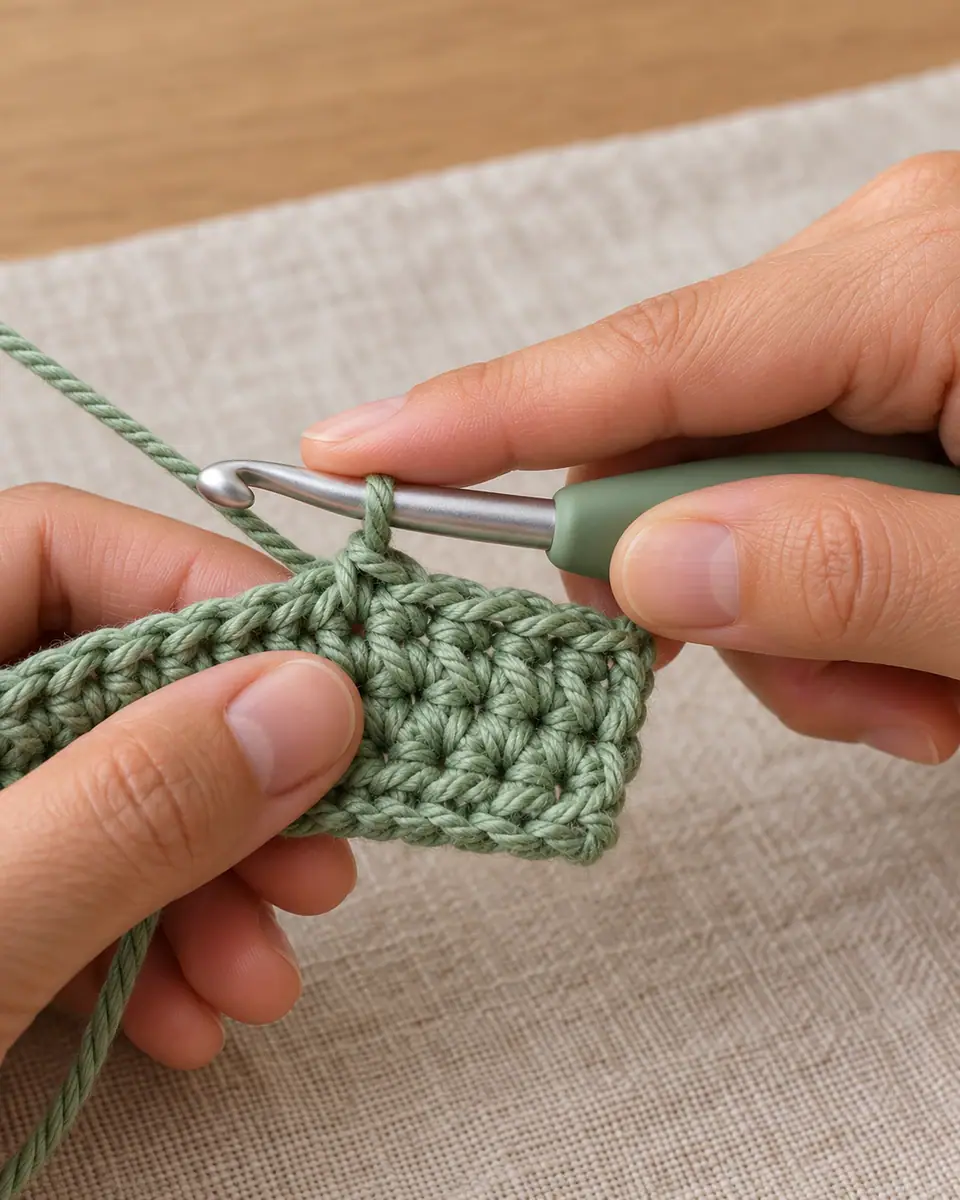
Hold the hook as you would hold a table knife: the handle lies under your palm, the index finger rests along the top and the thumb sits underneath. The movement comes more from the wrist and forearm. Many people who crochet for hours find it more relaxed on the shoulder.
Try both for a few rows and keep the one that feels natural. There is no wrong grip as long as your stitches come out even and your hand does not ache.
Tensioning the yarn
The other hand feeds the yarn to the hook at a steady tension. A common way is to bring the yarn from the ball under the little finger, over the ring and middle fingers and over the raised index finger. The index finger then lifts the yarn toward the hook, while the thumb and middle finger hold the work just under the stitch you are making.
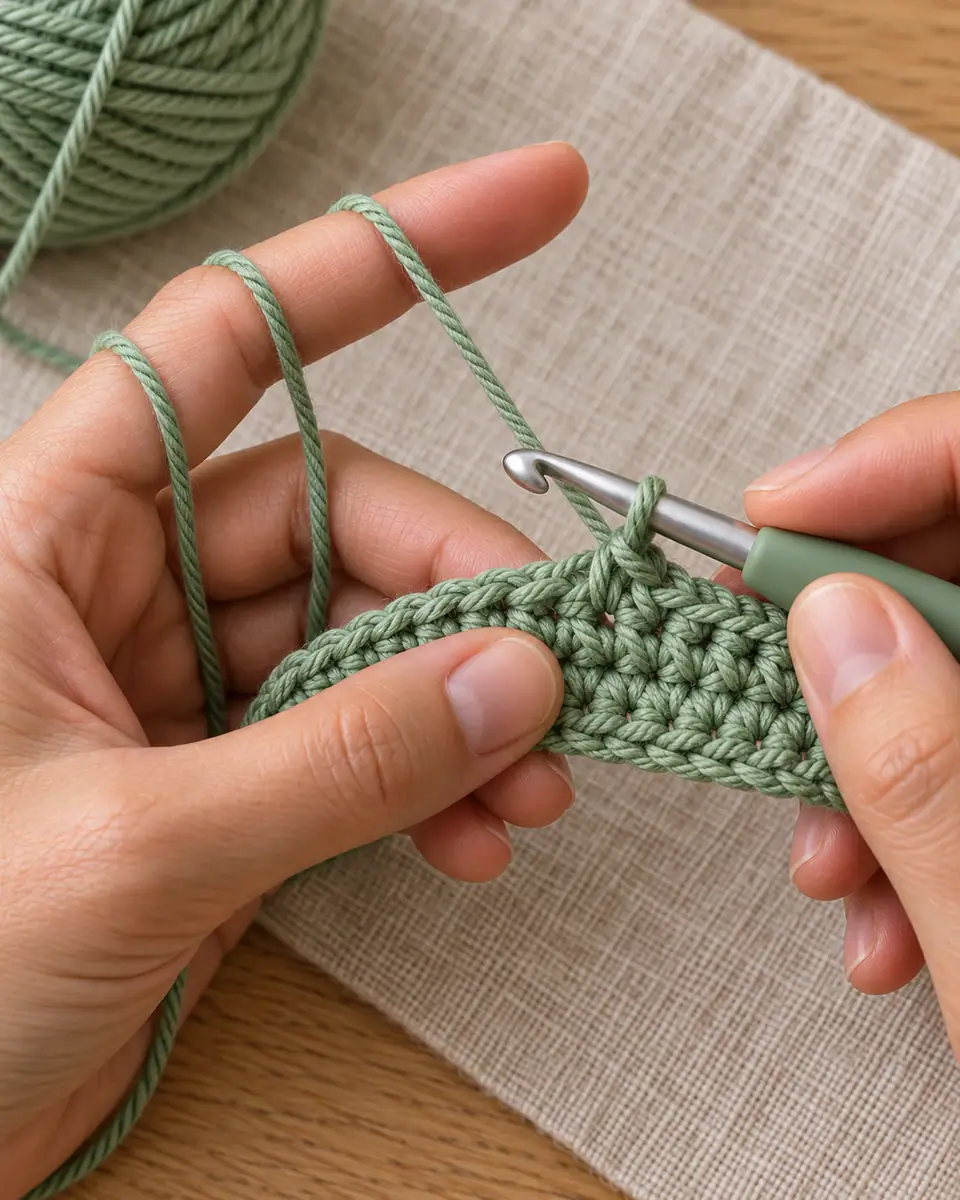
Tension takes the longest to learn. If your stitches are so tight that the hook will not go into them, loosen the yarn around your fingers. If they are loose and loopy, wrap the yarn once more around the little finger. Expect the first few rows to be uneven; that is normal, and it settles with practice, not with effort.
How to Crochet: Your First Stitches, in Order
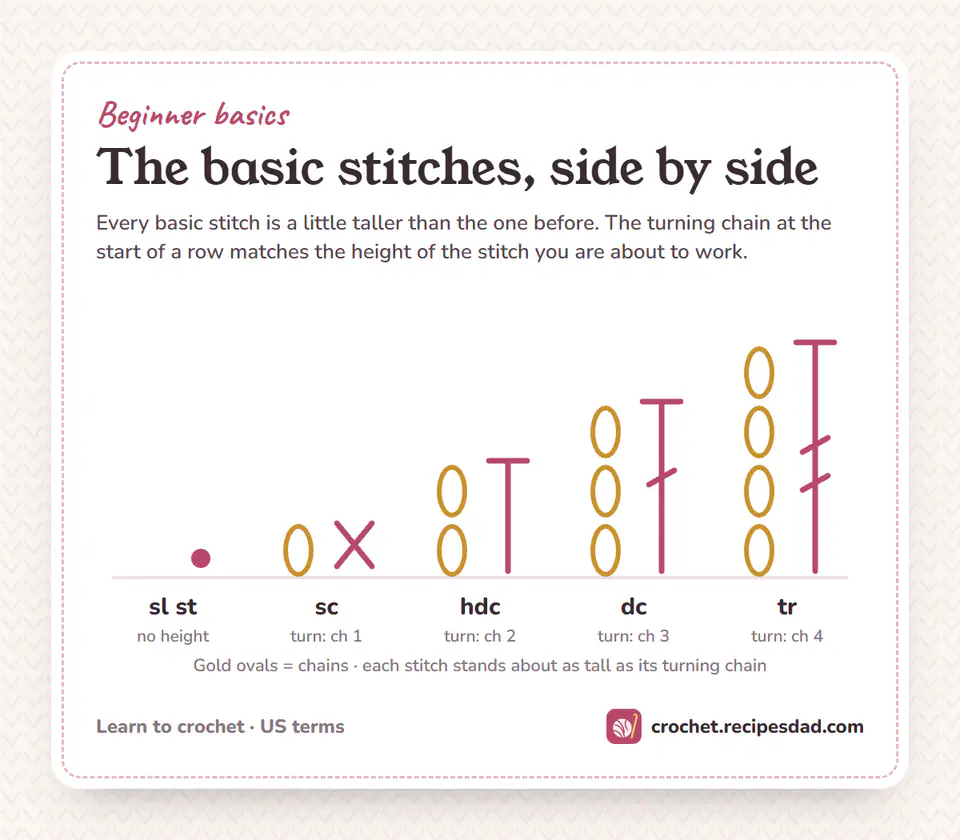
Almost every crochet stitch is made of the same two movements: yarn over (wrap the yarn over the hook from back to front) and pull through (draw that yarn through a stitch or through loops on the hook). The taller stitches just add more yarn overs. Learn them in this order and each one builds on the last.
- Slip knot and chain. The slip knot puts the first loop on the hook, and a row of chains is the base of most flat projects. Start with our chain stitch lesson, which also covers the slip stitch.
- Single crochet (sc). The shortest of the basic stitches and the one you will use most. It makes a firm, dense fabric. See how to single crochet.
- Half double crochet (hdc). One yarn over more than single crochet, a little taller and softer. See half double crochet.
- Double crochet (dc). The tall, quick stitch behind granny squares and most blankets. See double crochet.
- Treble crochet (tr). Two yarn overs at the start, for very tall, open stitches. See treble crochet.
After those come the skills that let you shape things: working in the round from a magic ring, adding and removing stitches with increases and decreases (sc2tog), and the finishing work of seaming, edging and blocking. When you are ready to follow written instructions, how to read crochet patterns explains the abbreviations and the punctuation.
One note on names: these are US terms. UK patterns call the same stitches by other names (a US single crochet is a UK double crochet), so check which terms a pattern uses before you start. The US ⇄ UK stitch converter translates a whole pattern.
Working in Rows and Counting
Flat pieces are worked in rows. At the end of each row you make a few chains, called the turning chain, and turn the work over like the page of a book, so the next row is worked back across the top of the one you just made. The turning chain lifts the yarn to the height of the next row: 1 chain for single crochet, 2 for half double, 3 for double and 4 for treble.
Count your stitches at the end of every row for the first few projects. Edges that grow wider or narrower are the most common beginner problem, and they always come from the first or the last stitch of the row: either a stitch worked into the turning chain by mistake, or the last stitch missed. A stitch marker in the first and the last stitch of each row makes them easy to find.
Common Beginner Mistakes and How to Fix Them
- The foundation chain is too tight. It pulls the bottom edge in like a drawstring. Make the chain with a hook one size larger, then switch back for the first row.
- The edges are wavy or slanted. You are adding or losing stitches at the ends of the rows. Count, mark the first and last stitch, and work into them every time.
- The hook catches the yarn and splits it. Turn the hook so the throat faces down slightly as you pull through, and use a smooth yarn while you learn.
- Your hand aches. You are gripping too hard. Relax the grip, try the other hold, take breaks and consider an ergonomic handle.
- You made a mistake three rows down. Take the hook out and pull the yarn gently: crochet unravels one stitch at a time, and you can stop exactly where you want. Put the loop back on the hook and continue.
A First Project to Practice On
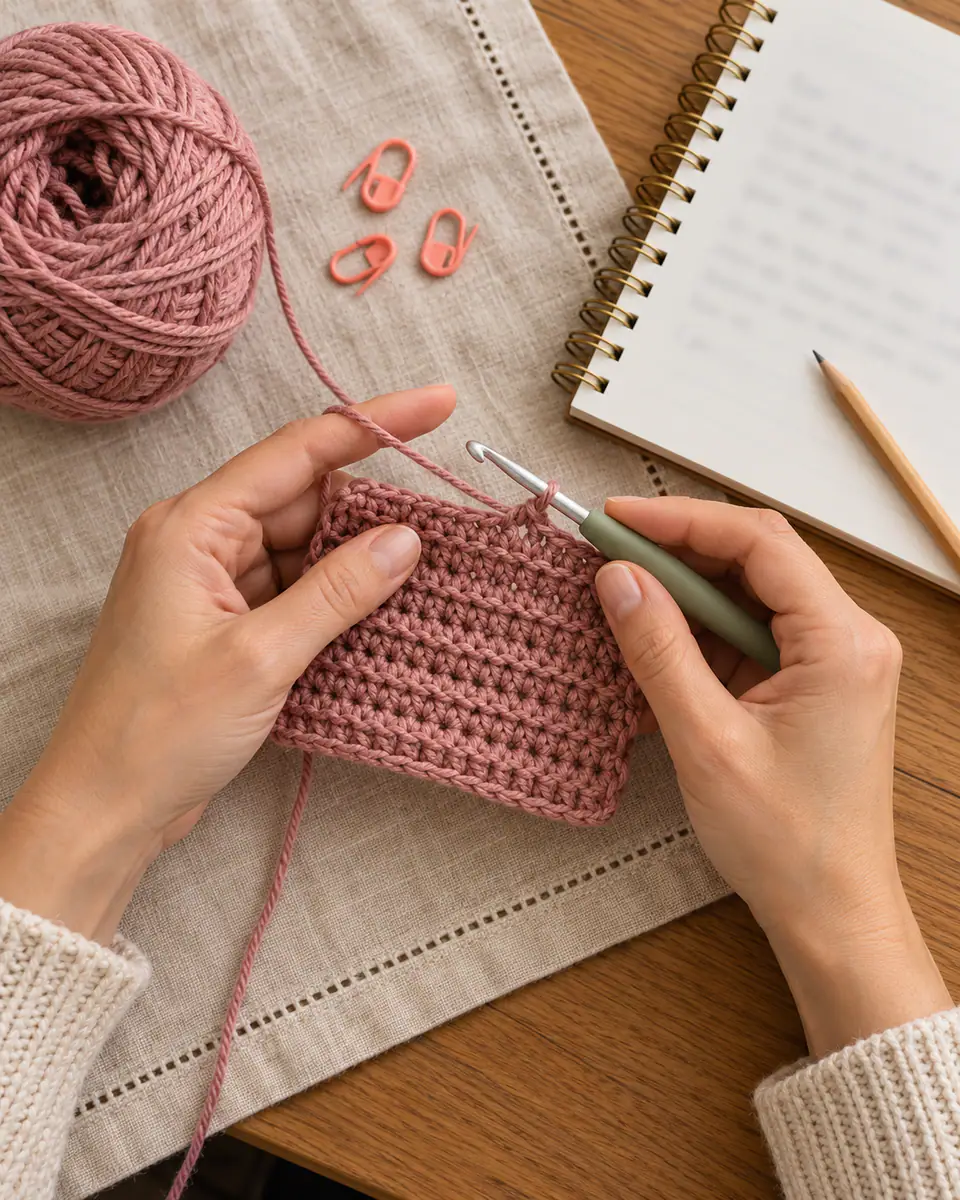
Start with a small square of single crochet. Chain 13, work a single crochet in the second chain from the hook and in each chain across, so you have 12 stitches, then chain 1, turn, and keep working rows of 12 until the piece is square. It teaches the chain, the stitch, turning and counting, and it shows you at once whether your tension is even.
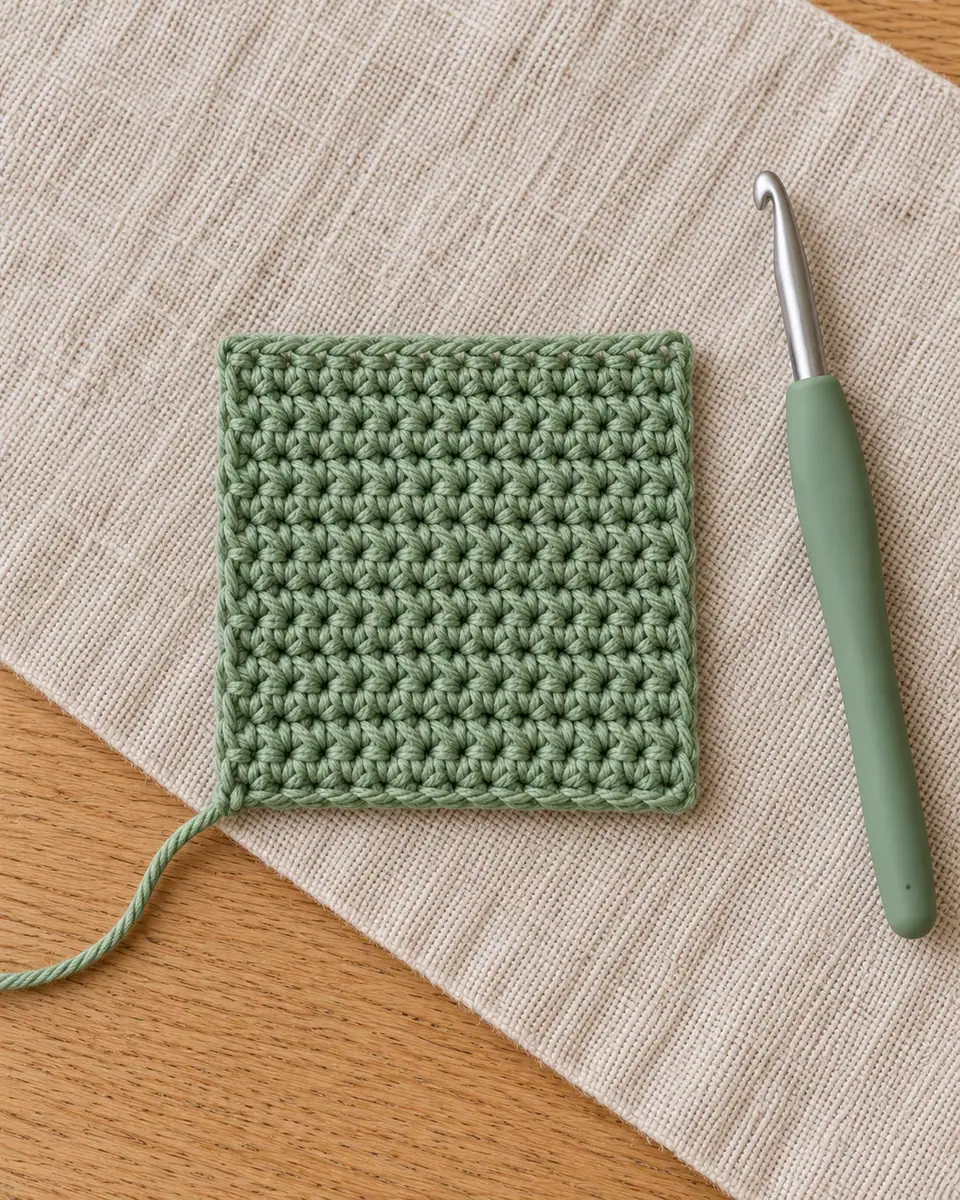
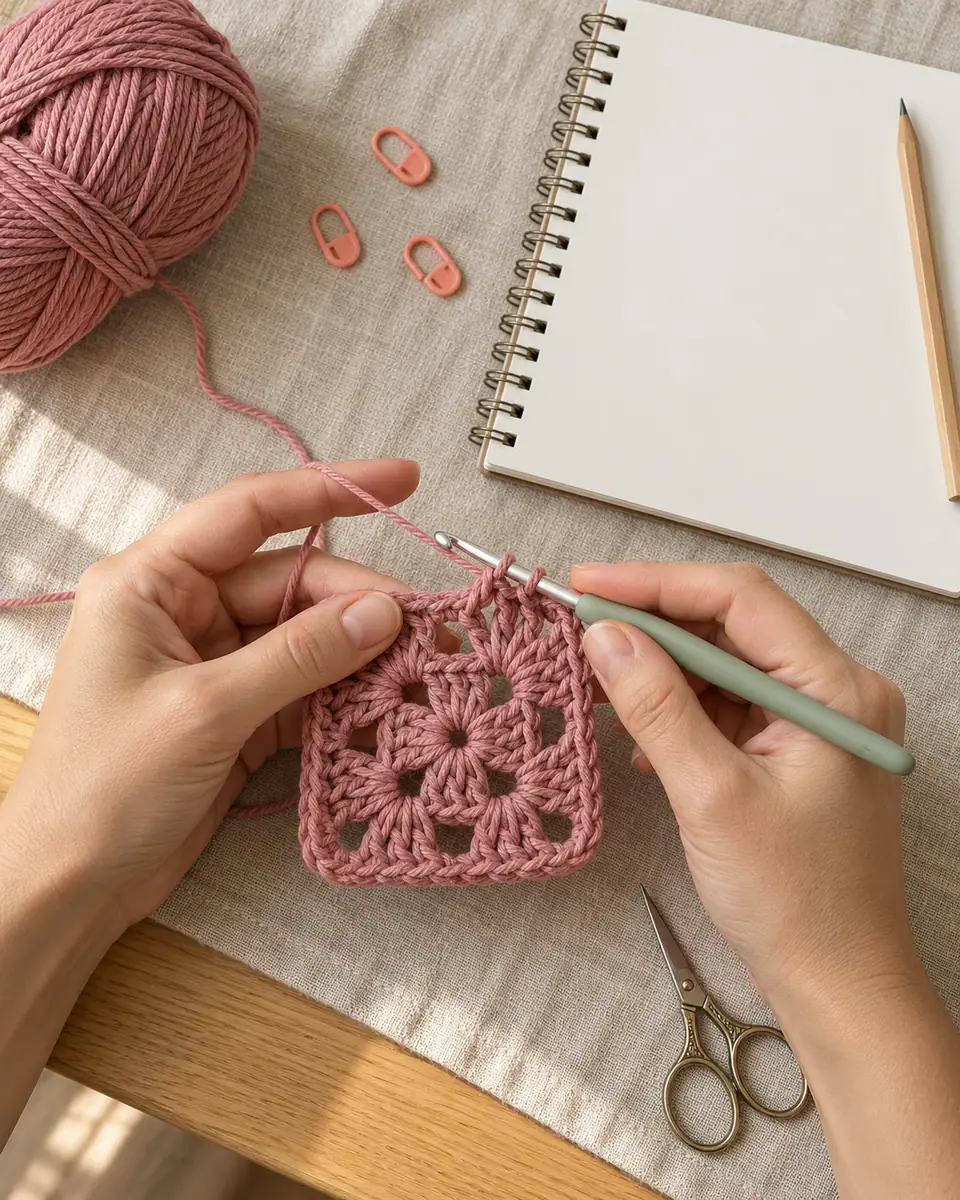
Once the square looks even, make a useful version: a cotton dishcloth of 30 single crochets worked until it is square. After that, good beginner crochet projects are flat and need no shaping, such as a scarf in half double crochet or a plain granny square. Our crochet heart is a nice next step: it uses a magic ring and four stitch heights in only two rounds.
Everything above is crochet for beginners in the true sense: no fancy stitches, just the movements every pattern is built from. When you want to learn to crochet a particular stitch in detail, every lesson in Learn to Crochet has close-up photos of each step.
Frequently Asked Questions
How to start crochet for beginners?
Start with a 5 mm hook, a light worsted weight yarn and the slip knot and chain. Then learn single crochet and practice it in rows on a small square until your stitches look even.
How to crochet for absolute beginners: what do I learn first?
Learn the slip knot, the chain and single crochet first, in that order. Everything else, from double crochet to granny squares, uses the same yarn over and pull through movements.
How long does it take to learn to crochet?
Most people can make a chain and rows of single crochet after an afternoon of practice. Even tension usually comes after a few small projects.
Is crochet easier than knitting?
Many people find crochet easier to start, because there is only one hook and one live loop at a time. A dropped stitch cannot run down the work, and mistakes are quick to undo.
Can left-handed people crochet?
Yes. Hold the hook in the left hand and the yarn in the right, and mirror every movement. Patterns work the same way; only shaped pieces with a right and left side may come out mirrored.
What size crochet hook should a beginner use?
A 5 mm (US H-8) or 5.5 mm (US I-9) hook with worsted weight (4) yarn. The loops are big enough to see and count, and the yarn is easy to tension.

Clara Parker
I’m Clara — a mom who is never without a hook, and the crochet half of the Recipes Dad family. I write cozy, practical patterns you can actually finish.
More about Clara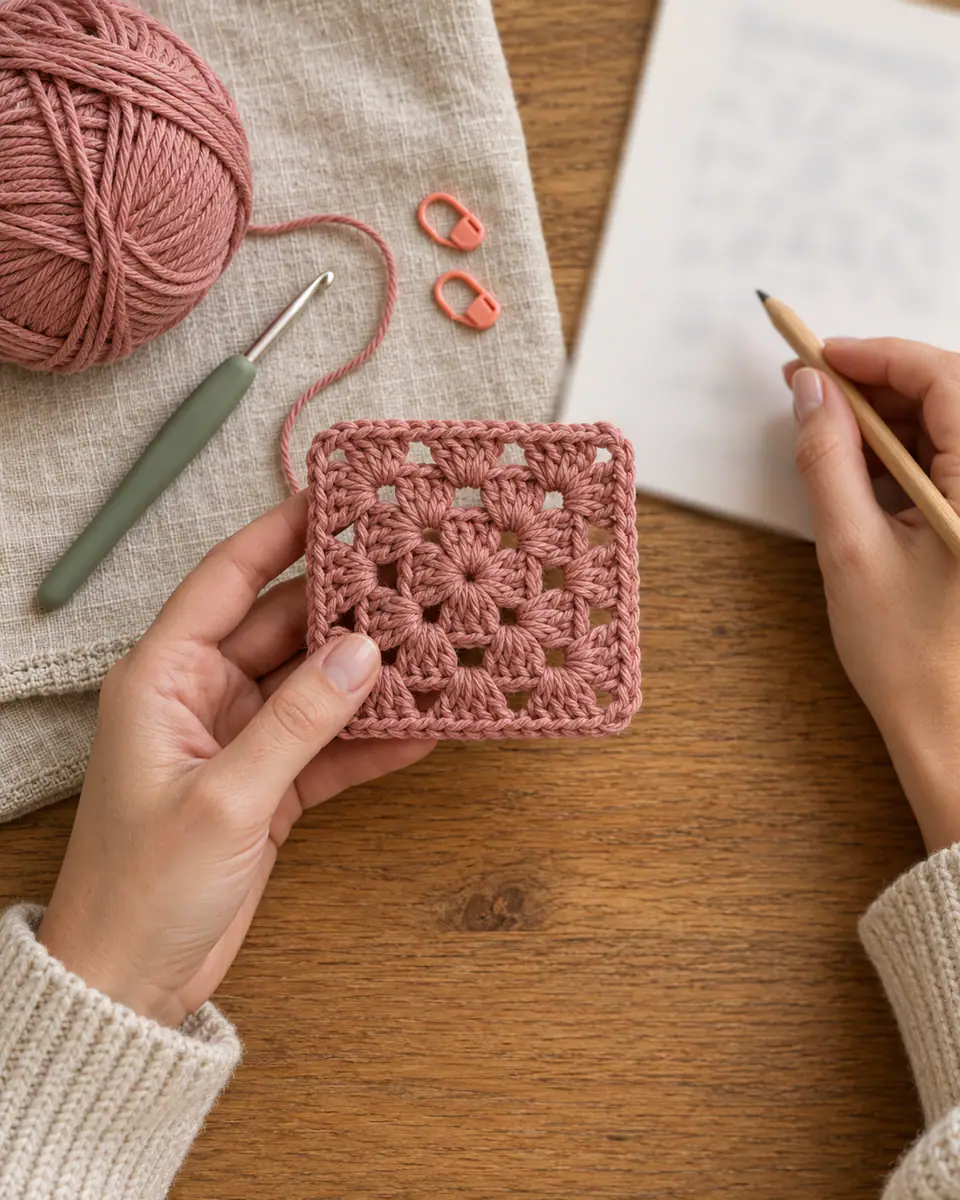
Maker notes
Made this pattern? Tell us about your yarn and colors, or ask a question about a row — Clara reads every note.